The Hafas Raw Data Format (HRDF) is a proprietary file format for timetable data.
Who is behind it?
The company Hacon has developed the Hacon Fahrplan-Auskunfts-System (HAFAS), which uses HRDF for data exchange.
Why does the Open Data platform offer this?
The HAFAS system (see above) is widely used in public transport, which has made HRDF one of the standards in the industry. It also covers many aspects of customer information that are not (currently) available in other formats.
You can find more information on the assessment of HRDF as a standard in the report (German) by the Federal Office of Transport (FOT).
Swiss public transport timetable data and journeys in the area close to the Swiss border.
Note: For cross-border trains, the Swiss part of the journey is included up to the first commercial stop abroad (in the direction of abroad) or the last commercial stop abroad (in the direction of Switzerland).
All information for an entire timetable period (e.g. 2024).
How is the information structured? (model)
An HRDF export consists of several files, which almost all have to be viewed together for an overall picture. For details, please refer to the realisation specification (RV v2.0.5 (July 2023, German) or RV v2.0.7 (May 2024)) and the official HRDF documentation (available on request: contact form).
To a certain extent, the HRDF file can be viewed as a database dump. The individual files in the ZIP correspond to individual tables or objects.
Please note:
NOMEN EST OMEN does NOT (always) apply to HRDF files. For example, the “BAHNHOF” file contains not only railway stations, but all stops (including bus stops, for example).
The format of the HRDF files is designed for a compact, machine-readable structure. Therefore:
are frequently related but not identical contents in the same file
contents are indicated with an “*” followed by a letter, e.g. “*Z” (so the interpreting system knows what comes next)
the structure of each line following an “*” is strictly regulated in the HRDF documentation. Each part of a line has a predetermined width (number of characters), the parts are separated by spaces. Example:
It can be defined that the first part of a line contains the ID of a stop and may only be 5 characters long and the next part (from character 6 to character 10) identifies the company owning the stop.
So the line could look like this: 12345_67891, where _ visualises the space. If there is no company and the field is optional, then characters 6-10 would only be spaces.
HRDF thus differs from other common file formats such as CSV, where content is separated with a comma, or JSON, where content is represented in a structured way (with various characters): content in HRDF is limited in its scope and position on each line.
There are files that are part of the HRDF export we provide that are empty. These are only included in the sense of interoperability of decreasing systems. We deliberately do NOT list them in the following description.
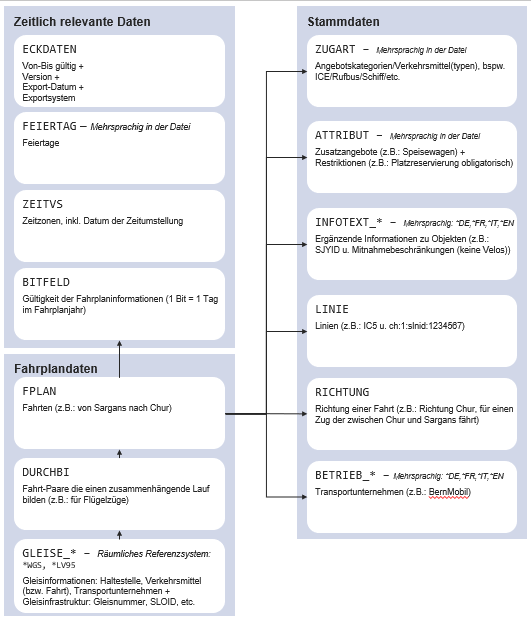
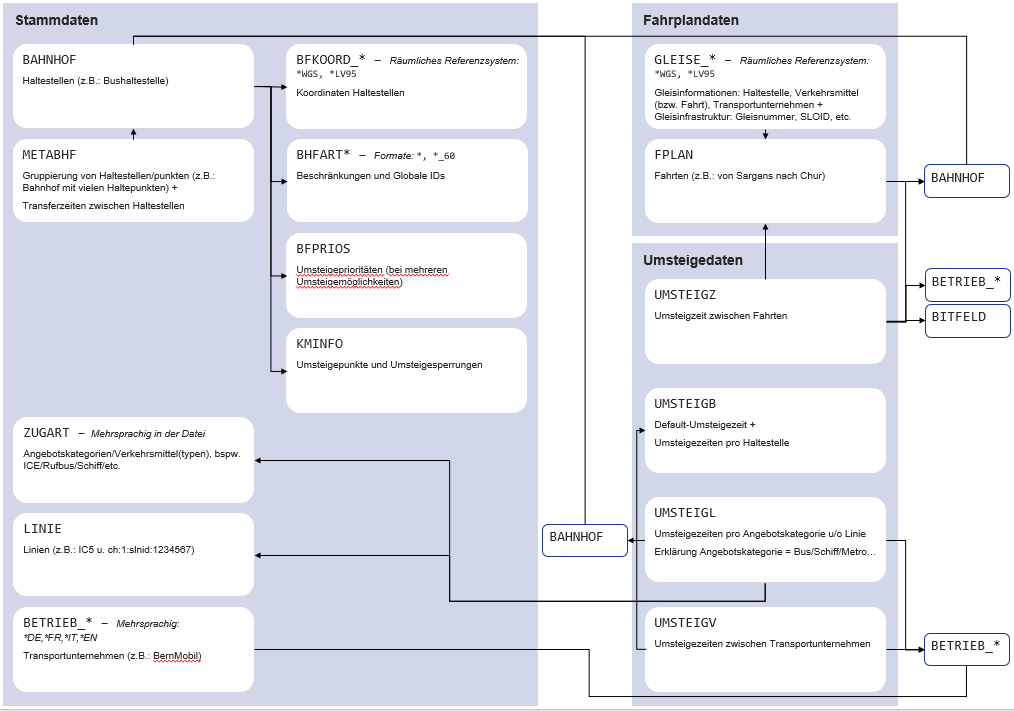
Overall, the HRDF data can be divided into (1) master data, (2) time-relevant data, (3) timetable data and (4) transfer data. We will go into the content in more detail below.
Technical Description
This section roughly describes each individual file of the HRDF model including examples from the HRDF export (detailed information can be found in the RV and HRDF documentation). In addition, we do not describe the files alphabetically, but starting from node files. For example, we first introduce FPLAN as one of the central files and then describe the files referenced by this file, etc. Thus we divide the description into:
Timetable file (FPLAN) and its references and general information
You need to find out:
when will
travelled from where to where
on which days of the year
By which means of transport
with which line
with which additional services and restrictions
with which further details (SJYID, etc.)
As well as for time-relevant information:
Validity
Public holidays
Time zones
Stops file (BAHNHOF) and its references
Needed for the following information on stops:
Name
Grouping of several stops
Coordinates of the stops
ID of the stops
Transfer information within and between stops
Timetable file (FPLAN) and its references and general information
Extract from the model overview. An arrow means that a key is “pointed to” in the referenced file:
Area
Specialised content
File name
Description
Time-relevant data
Validity of the delivery
ECKDATEN
Life of the timetable
The timetable data is valid for the defined period. The duration usually corresponds to that of the timetable period
Can be read in decoupled from other data.
Time-relevant data
General public holidays
FEIERTAG
List of public holidays that apply in Switzerland.
In addition to the date of the holiday, the description of the holiday is listed in four languages: DE, FR, IT, EN
Can be read in decoupled from other data.
Time-relevant data
Time zones
ZEITVS
Definition of the time zones, including the date when the summer and winter time changes take place
Further details on this topic and its implementation in Switzerland can be found in the RV
There are 2 types of representation:
Type 1:
Railway station number
(general) time difference compared to GMT
Time difference that applies to the following period
FromDate (the time difference applies from this day)
Time (from this time)
UntilDate (the time difference applies until this date)
Time (at this time)
Comment (further time periods are also available in the Swiss export, before the comment)
Day-specific definition of the validity of the timetable information. The validity is defined using a bit pattern. Each day is mapped with one bit. Four bits are combined to form a hexadecimal digit. Each bit pattern receives a code. The perpetual patterns have the same code every year. Otherwise, new patterns that are defined for their timetables according to the requirements of the transport companies receive new codes.To interpret the bit field, it is important to understand how the timetable years work (more information here). A timetable year usually lasts one year, but the timetable year begins on the 2nd weekend in December. This means that a timetable year is not always the same length. To deal with this, the bit field is assumed to be 400 days long.File contains:
Bit field codeBit field definition
Example (excerpt) – Hex insetead of bits:
...
000017 FFFFFFFFFFFFFFFFFFFFFFFFFFFFFFFFFFFFFFFFFFFFFFFFFFFFFFFFFFFFFFFFFFFFFFFFFFFFFFFFFFFFFFFFFFFFFE00 % Bitfeld 17 repräsentiert die Nr FF...00
...
Timetable data
Timetable
FPLAN
List of journeys and by far the largest and most comprehensive file in the HRDF export.
This file contains:
*Z lines: as header information for the run. Further details on this topic and its implementation in Switzerland can be found in the RV. It includes:
The journey number (primary key with the TU code)
Transport company (TU) code (see File BETRIEB_*)
For the TU code = 801, the region information must also be taken into account. This information is contained in line *I with the INFOTEXTCODE RN.
Option
‘Variant’ information does not exist in the HRDF standard. It is a speciality in the Swiss public transport system which has no technical significance. It is assigned by INFO+. The value is not to be taken into account for the publication and may not be used for use cases.
(optional) Number of cycles
(optional) Cycle time in minutes
Example (excerpt):
*Z 000003 000011   101         % Fahrtnummer 3, für TU 11 (SBB), mit Variante 101 (ignore)
...
*Z 123456 000011   101 012 060 % Fahrtnummer 123456, für TU 11 (SBB), mit Variante 101 (ignore), 12 mal, alle 60 Minuten
...
*G-lines: Reference to the offer category (s. ZUGART file). It includes:
Reference to the offer category
The term “Angebotskategorie” (offer category) may have a different meaning here than in colloquial language! A colloquial term (also according to the HRDF doc.) would be “transport mode type”.
Stop from which the offer category applies
Stop up to which the offer category applies
Example (excerpt):
*Z ...
*G ICE 8500090 8503000 % Angebotskategorie ICE gilt ab HS-Nr. 8500090 bis HS-Nr. 8503000
...
*A VE lines: Reference to the validity information (see file BITFELD). Further details on this topic and its implementation in Switzerland can be found in the RV. It includes:
Stop from which the offer category applies
Stop up to which the offer category applies
Reference to the validity information. In Switzerland: 000000 = always.
Example (excerpt):
*Z ...
*G ...
*A VE 8500090 8503000 001417 % Ab HS-Nr. 8500090 bis HS-Nr. 8503000, gelten die Gültigkeitstage 001417 (Bitfeld für bspw. alle Montage)
...
*A *-lines: Reference to offers (s. file ATTRIBUT). It includes:
The offer code
The term “Angebot” (offer) may be imprecise here. The HRDF doc. uses the word “Attribut” (attribute), which is also somewhat imprecise. Basically, it is a collective term for extensions (e.g. dining car) or restrictions (e.g. no bicycles) that apply.
Stop from which the offer category applies
Stop up to which the offer category applies
Reference to the validity information
Example (excerpt):
*Z ...
*G ...
*A VE ...
*A R  8500090 8503000        % Attribut R gilt ab HS-Nr. 8500090 bis HS-Nr. 8503000
*A WR 8500090 8503000 047873 % Attribut WR gilt ab HS-Nr. 8500090 bis HS-Nr. 8503000 mit den Gültigkeitstagen 047873
*A VR 8500090 8503000        % Attribut VR gilt ab HS-Nr. 8500090 bis HS-Nr. 8503000
...
*I-lines: Reference to notes (s. INFOTEXT file). Further details on this topic and its implementation in Switzerland can be found in the RV. It includes:
Informational text code. In Switzerland: XI not supported. Permitted codes see list (DE / FR).
Stop from which the info text applies
Stop up to which the info text applies
Reference to the validity information. In Switzerland: If not available = always.
Reference to the info text
Departure time
Time of arrival
Comments:
The Swiss Journey ID (SJYID) is identified via the *I line with the code JY
Example (excerpt):
*Z ...
*G ...
*A VE ...
*A ...
*I hi 8573602 8587744       000018040             % Hinweis auf Infotext (hi) ab HS-Nr. 8573602 bis HS-Nr. 8587744  mit Infotext 18040
*I hi 8578157 8589334       000018037 01126 01159 % Hinweis auf Infotext (hi) ab HS-Nr. 8578157 bis HS-Nr. 8589334 mit Infotext 18037 Abfahrt 11:26 Ankunft 11:59
...
*L lines: Line information or reference to the line information (see file LINIE). It includes:
Line information, reference to external file if necessary.
Stop from which the line is valid
Stop to which the line is valid
Departure time
Time of arrival
Example (excerpt):
*Z ...
*G ...
*A VE ...
*A ...
*I ...
*L 8        8578157 8589334 01126 01159 % Linie 8 ab HS-Nr. 8578157 bis HS-Nr. 8589334 Abfahrt 11:26 Ankunft 11:59
*L #0000022 8589601 8589913             % Referenz auf Linie No. 22 ab HS-Nr. 8589601 bis HS-Nr. 8589913
...
*R lines: Reference to the direction text (see file RICHTUNG / DIRECTION). It includes:
Direction (H=forward,R=backward)
Reference to direction code
Stop from which the direction applies
Stop to which the direction applies
Departure time
Time of arrival
Comments:
R without information = no direction
Example (excerpt):
*Z ...
*G ...
*A VE ...
*A ...
*I ...
*L ...
*R H                         % gilt für die gesamte Hin-Richtung
*R R R000063 1300146 8574808 % gilt für Rück-Richtung 63 ab HS-Nr. 1300146 bis HS-Nr. 8574808
...
*GR lines: supported but not available in Switzerland.
*SH lines: supported but not available in Switzerland.
*CI/CO lines: It includes:
Number of minutes at check-in(CI)/out(CO)
Stop from which the direction applies
Stop to which the direction applies
Departure time
Time of arrival
Example (excerpt):
*Z ...
*G ...
*A VE ...
*A ...
*I ...
*L ...
*R ...
*CI 0002 8507000 8507000 % Check-in 2 Min. ab HS-Nr. 8507000 bis HS-Nr. 8507000
...
*CO 0002 8507000 8507000 % Check-out 2 Min. ab HS-Nr. 8507000 bis HS-Nr. 8507000
...
Once all the lines described have been defined, the run is described with the journey times:
Stop (s. BAHNHOF and others)
Arrival time: Negative = No possibility to get out
Service categories (aka means of transport (type))
ZUGART
List of service categories. Per language the (Class:) grouping of offer categories with identical characteristics. (Option:) Search criteria for the application for connection search. (Categorie:) Designation of the offer category.
Note again: The term “Angebotskategorie* (offer category) may have a different meaning here than in colloquial language! A colloquial term (also according to the HRDF doc.) would be “means of transport” (type).
...
IC  1 A 0 IC  0   #014 % Code "IC",  Kategorie 1, Tarifgruppe A, Ausgabesteuerung 0, Gattungsbezeichnung IC,  Zuschlag 0
ICE 0 A 0 ICE 0   #015 % Code "ICE", Kategorie 0, Tarifgruppe A, Ausgabesteuerung 0, Gattungsbezeichnung ICE, Zuschlag 0
...
RUB 6 A 0 RUB 0 B #026 % Code "RUB", Kategorie 6, Tarifgruppe A, Ausgabesteuerung 0, Gattungsbezeichnung RUB, Zuschlag 0, Flag B (Schiff)
...
Introduction Text definition with <text>
Specify language with e.g. <German>
Product classes:
Product class Number between 0-13
Product text
Example (excerpt):
...
<text>                                                  % Keyword für Textdefinition
<Deutsch>                                               % Sprache ist Deutsch
class00 ICE/EN/CNL/ES/NZ/TGV/THA/X2                     % Produktklasse 00 steht für ICE, EN, usw.
class01 EuroCity/InterCity/ICN/InterCityNight/SuperCity % Produktklasse 01 steht für EuroCity, InterCity, usw.
class02 InterRegio/PanoramaExpress                      % Produktklasse 02 steht für InterRegio, PanoramaExpress
...
Options:
Option definition Number between 10-14 (Further details on this topic and the implementation in Switzerland can be found in the RV)
Example (excerpt):
...
option10 nur Direktverbindungen  % Option 10 steht für nur Direktverbindungen
option11 Direkt mit Schlafwagen* % Option 10 steht für Direkt mit Schlafwagen
option12 Direkt mit Liegewagen*  % Option 10 steht für Liegewagen
...
Categories:
Generic long name number Number between 0-999 (see above)
Example (excerpt):
...
category014 InterCity        % Kategorie 14 steht für InterCity
category015 InterCityExpress % Kategorie 15 steht für InterCityExpress
...
category026 Rufbus           % Kategorie 26 steht für Rufbus
...
Master data
Offers
ATTRIBUT
List of abbreviations describing additional offers (e.g.: dining car) or restrictions (e.g.: seat reservation obligatory).
Note again: The term “Angebot” (offer) may be imprecise here. The HRDF doc. uses the word “attribute”, which is also somewhat imprecise. Basically, it is a collective term for extensions (e.g. dining car) or restrictions (e.g. no bicycles) that apply. An overview of the means of transport (and instructions) can be found in the following link: Lists of means of transport and instructions
This file contains:
The list of offers
Example (excerpt):
...
Y  0   5  5 % Der Code Y gilt für den Fahrtabschnitt (0) mit Priorität 5 und Sortierung 5
YB 0   5  5 % s.o. für Code YB
YM 0   5  5 % s.o. für Code YB
...
Description of how the offers can be displayed. This information is actively maintained in the timetable collection
Example (excerpt):
...
# Y  Y  Y  % Attributcode Y soll als Y für Teilstrecke und als Y für Vollstrecke ausgegeben werden
# YB YB YB % s.o. für Attributscode YB
# YM YM YM % s.o. für Attributscode YM
...
Description in the following languages : German, English, French, Italian
Example (excerpts):
...
<text>                % Keyword für Textdefinition
<deu>                 % Sprache ist Deutsch
...
Y  Zu Fuss            % Code Y, mit Beschrieb Zu Fuss
YB Zu Fuss und Bus    % Code YB, mit Beschrieb Zu Fuss und Bus
YM Zu Fuss und Metro  % Code YM, mit Beschrieb Zu Fuss und Metro
...
<fra>                 % Sprache ist Französisch
...
Y  A pied             % Code Y
YB A pied et en bus   % Code YB
YM A pied et en métro % Code YM
...
Master data
Info texts
INFOTEXT_*
*DE,*FR,*IT,*EN
Additional information on objects (journeys, lines, etc.). This information can either be
be simple texts, e.g.: 000018154 Rollstühle können mit Unterstützung des Fahrpersonals befördert werden. OR
Values with semantic meaning. This means values that cannot be represented in any other way and have therefore been “outsourced” to INFOTEXT, e.g. 000000000 ch:1:sjyid:100001:3-002
The INFOTEXTCODE attribute defines whether these are simple texts or texts with a semantic meaning. The INFOTEXTCODE is not in the INFOTEXT file, but only in the INFOTEXT referencing files, e.g. FPLAN.
A list of the INFOTEXTCODE used can be found under the following LINK..
Master data
Lines
LINIE
List of lines. The file contains:
Line ID (not unique line by line!)
Line property code
Characteristic
The following property codes are supported:
Line type K : Line key
Line type W : internal line designation
Line type N T : Line abbreviation
Line type L T : Line name
Line type R T : Line region name (reserved for FOT ID)
Line type D T : Line description
Line type F : Line colour
Line type B : Line background colour
Line type H : Main line
Line type I : Line info texts
Example (excerpt):
...
0000001 K ch:1:SLNID:33:1     % Linie 1, Linienschlüssel ch:1:SLNID:33:1
0000001 W interne Bezeichnung % Linie 1, interne Linienbezeichnung "interne Bezeichnung"
0000001 N T Kurzname          % Linie 1, Linienkurzname "Kurzname"
0000001 L T Langname          % Linie 1, Linienlangname "Langname"
0000001 D T Description       % Linie 1, Linienbeschreibung "Description"
0000001 F 001 002 003         % Linie 1, Linienfarbe RGB 1, 2, 3
0000001 B 001 002 003         % Linie 1, Linienhintergrundfarbe RGB 1, 2, 3
0000001 H 0000002             % Linie 1, Hauptlinie 2
0000001 I TU 000000001        % Linie 1, Infotexttyp TU, Infotextnummer (s. INFOTEXT-Datei)
...
0000010 K 68                  % Linie 10, Linienschlüsse 68
0000010 N T 68                % Linie 10, Linienkurzname 68
0000010 F 255 255 255         % Linie 10, Linienfarbe RGB 255, 255, 255
0000010 B 236 097 159         % Linie 10, Linienhintergrundfarbe RGB 236, 097, 159
...
Master data
Direction
RICHTUNG
Directional information. More details:
Direction ID (see FPLAN)
RichtungsText
For example, if a train travels between Sargans and Chur, it is labelled as travelling in the direction of Chur.
Example (excerpt):
...
R000011 Esslingen    % Richtung 11 nach Esslingen
R000012 Zollikerberg % Richtung 12 nach Zollikerberg
R000013 Forch        % Richtung 13 nach Forch
R000014 Egg          % Richtung 14 nach Egg
...
Master data
Transport company
BETRIEB_**DE,*FR,*IT,*EN
List of transport companies. The term “transport company” is understood in different ways. In the context of opentransportdata.swiss, it is understood that it is an organisation that is responsible for the runs described in the FPLAN. A detailed description of the transport companies and business organisations can be found here.
Each TU is described in detail with 2 lines:
The first line:
Operator no. (for BETRIEB / OPERATION file)
Short name (after the “K”)
Long name (after the “L”)
Full name (after the”V”)
The second line:
Operator no. (for BETRIEB / OPERATION file)
“:”
TU code (or administration number)
Several TU codes can be listed. These share the information in the first line.
Example (excerpt):
...
00379 K "SBB" L "SBB" V "Schweizerische Bundesbahnen SBB"     % Betrieb-Nr 00379, kurz sbb, lang sbb, voll schweizerische bundesbahn sbb
00379 : 000011                                                % Betrieb-Nr 00379, TU-Code 000011
00380 K "SOB" L "SOB-bt" V "Schweizerische Südostbahn (bt)"   % Betrieb-Nr 00380, kurz sob, lang sob-bt,  voll schweizerische südostbahn (bt)
00380 : 000036                                                % Betrieb-Nr 00380, TU-Code 000036
00381 K "SOB" L "SOB-sob" V "Schweizerische Südostbahn (sob)" % Betrieb-Nr 00381, kurz sob, lang sob-sob, voll schweizerische südostbahn (sob)
00381 : 000082                                                % Betrieb-Nr 00381, TU-Code 000082
...
Stops file (BAHNHOF) and its references
Extract from the model overview. An arrow means that a key is “pointed to” in the referenced file. For a better overview, BAHNHOF / STATION and BETRIEB / OPERATION are represented by placeholders.
Not repeated: ZUGART, LINIE, BETRIEB_*, FPLAN:
Bereich
Fachlicher Inhalt
Dateiname
Beschreibung
Master data
Stops
BAHNHOF
List of stops A detailed description of the stops (incl. Meta-stops (see METABHF file)) can be found here.
The file contains stops that are referenced in various files:
Stop number, from DiDok (in future atlas), with a 7-digit number >= 1000000
The first two numbers are the UIC country code
Stop name with up to 4 types of designations:
Up to “$<1>”: official designation from DiDok/atlas
Up to “$<2>”: long designation from DiDok/atlas
Up to “$<3>”: Abbreviation from DiDok/atlas
Up to “$<4>”: alternative designations from the timetable collection
Example (excerpt):
...
8500009     Pregassona, Scuola Medialt;1>                                             % HS-Nr 8500009 mit off. Bez. Pregassona, Scuola Media
8500010     Basel SBBlt;1>$BSlt;3>$Balelt;4>$Basilea FFSlt;4>$Basle SBBlt;4>$Bâle CFFlt;4> % HS-Nr 8500010 mit off. Bez. Basel SBB, lang. Bez. BS, etc.
8500016     Basel St. Johannlt;1>$BSSJlt;3>                                            % HS-Nr 8500016 mit off. Bez. Basel St. Johann, Abkürzung BSSJ
...
Auxiliary stops have an ID < 1000000.
They serve as a meta operating point and as an alternative to the name of the DiDok/atlas system. They allow you to search for services with these names in an online timetable without knowing the exact name of the stop according to DiDok/atlas.
Example – Search for Basel instead of “Basel SBB” (excerpt):
Grouping of stops for the search. By grouping the stops, the search for transport chains takes place at all stops in the group.
There are 2 parts. file contains:
Part One – Transitional Relationships:
*A-line: Transition
followed by the attribute code
Meta stop ID
Stop ID
Transition time in minutes
Part two – stop groups:
Number of the collective term
“:”
Numbers of the summarised stops
Example (excerpt):
The stop 8500010 = “Basel SBB” includes the actual stops (see BAHNHOF file)
8500146 = “Basel, railway station entrance Gundeldingen$<1>$Basel, railway station entrance Gundeldingen$<2>”
8578143 = “Basel, Bahnhof SBB$<1>”
...
*A Y                             % *A=Übergang, Y="Fussweg" (s. ATTRIBUT-Datei)
8500010 8500146 009              % Meta-HS-Nr. 8500010, HS-Nr. 8500146, Übergang-Minuten: 9
*A Y                             % *A=Übergang, Y="Fussweg" (s. ATTRIBUT-Datei)
8500010 8578143 006              % Meta-HS-Nr. 8500010, HS-Nr. 8578143, Übergang-Minuten: 6
...
8389120: 8302430 8389120         % Gruppe: 8389120, umfasst: 8302430, und 8389120
8500010: 8500010 8500146 8578143 % Gruppe: 8500010, umfasst: 8500010, 8500146, und 8578143
8500016: 8500016 8592322         % Gruppe: 8500016, umfasst: 8500016, und 8592322
...
Master data
Stop coordinates
BFKOORD_*
*WGS84, *LV95
List of stops with their geo-coordinates. File contains:
Stop number
Longitude
Latitude
Height
Example (excerpt):
...lv95-Datei:
8500009    2718660    1098199   0      % HS-Nr. 8500009 LV-Läng. 2718660 LV-Breit. 1098199 Höhe 0 //Pregassona, Scuola Media
8500010    2611363    1266310   0      % HS-Nr. 8500010 LV-Läng. 2611363 LV-Breit. 1266310 Höhe 0 //Basel SBB
8500016    2610076    1268853   0      % HS-Nr. 8500016 LV-Läng. 2610076 LV-Breit. 1268853 Höhe 0 //Basel St. Johann
...wgs84-Datei:
8500009    8.971045   46.024911 0      % HS-Nr. 8500009 LV-Läng. 8.971045 LV-Breit. 46.024911 Höhe 0 //Pregassona, Scuola Media
8500010    7.589563   47.547412 0      % HS-Nr. 8500010 LV-Läng. 7.589563 LV-Breit. 47.547412 Höhe 0 //Basel SBB
8500016    7.572529   47.570306 0      % HS-Nr. 8500016 LV-Läng. 7.572529 LV-Breit. 47.570306 Höhe 0 //Basel St. Johann
...
Master data
Station type
BHFART*
*, *_60
Definition of the type of stops, i.e. whether the stop should be able to serve as a start and/or destination, or as a via location, and whether it has a global ID (for Switzerland the Swiss Location ID (SLOID)).
The BHFART_60 variant of the BHFART file also contains the risers (with an “a” as a prefix) of the stations (with an “A” as a prefix). So if the example below says “A”, it describes a stop and not a platform belonging to this stop. A stop can have several platforms (i.e., for example, places to board and alight at the stop in question). File contains:
Restrictions:
These stops are not to be offered as start, destination or via entries
.....bhfart
% Beschränkungen
0000132 B 3                     % Bahn-2000-Strecke % HS-Nr. 0000132 Auswahlbeschränkung
0000133 B 3                     % Centovalli        % HS-Nr. 0000133 Auswahlbeschränkung
...
% Globale IDs
...
8500009 G a ch:1:sloid:9        % HS-Nr. 8500009, Typ: SLOID-HS, SLOID = ch:1:sloid:9
8500010 G a ch:1:sloid:10       % HS-Nr. 8500010, Typ: SLOID-HS, SLOID = ch:1:sloid:10
8500016 G a ch:1:sloid:16       % HS-Nr. 8500016, Typ: SLOID-HS, SLOID = ch:1:sloid:16
.....bhfart_60
% Beschränkungen
0000132 B 3                     % Bahn-2000-Strecke % HS-Nr. 0000132 Auswahlbeschränkung
0000133 B 3                     % Centovalli        % HS-Nr. 0000133 Auswahlbeschränkung
...
% Globale IDs
...
8500010 G A ch:1:sloid:10       % HS-Nr. 8500010, Typ: SLOID-HS,    SLOID = ch:1:sloid:10
8500010 G a ch:1:sloid:10:3:5   % HS-Nr. 8500010, Typ: SLOID-Steig, SLOID = ch:1:sloid:10:3:5
8500010 G a ch:1:sloid:10:22:35 % HS-Nr. 8500010, Typ: SLOID-Steig, SLOID = ch:1:sloid:10:22:35
8500010 G a ch:1:sloid:10:3:6   % ...
8500010 G a ch:1:sloid:10:2:4   % ...
8500010 G a ch:1:sloid:10:4:8   % ...
8500010 G a ch:1:sloid:10:4:7   % ...
8500010 G a ch:1:sloid:10:7:15  % ...
8500010 G a ch:1:sloid:10:8:16  % ...
8500010 G a ch:1:sloid:10:7:14  % ...
8500010 G a ch:1:sloid:10:5:10  % ...
8500010 G a ch:1:sloid:10:6:11  % ...
8500010 G a ch:1:sloid:10:6:12  % ...
8500010 G a ch:1:sloid:10:0:20  % ...
8500010 G a ch:1:sloid:10:21:30 % ...
8500010 G a ch:1:sloid:10:21:31 % ...
8500010 G a ch:1:sloid:10:2:3   % ...
8500010 G a ch:1:sloid:10:1:1   % ...
8500010 G a ch:1:sloid:10:1:2   % ...
8500010 G a ch:1:sloid:10:22:33 % ...
8500010 G a ch:1:sloid:10:8:17  % ...
8500010 G a ch:1:sloid:10:0:19  % HS-Nr. 8500010, Typ: SLOID-Steig, SLOID = ch:1:sloid:10:0:19
8500010 G a ch:1:sloid:10:5:9   % HS-Nr. 8500010, Typ: SLOID-Steig, SLOID = ch:1:sloid:10:5:9
...
Caveat: There are currently no different sloids for sectors and sector groups. However, these can have their own coordinates. Depending on the application, the sloid (if it is used as an id) should be supplemented with “: “+”designation” (e.g. ch:1:sloid:7000:501:34:AB) in the internal system. However, this is NOT a new official ID.
Master data
Transfer priority
BFPRIOS
Definition of the priority of the stops The transfer priority allows you to select the transfer point if there are several transfer options. It is shown with a value between 0 and 16, where 0 is the highest priority and 16 is the lowest priority. File contains:
HS no.
Priority
HS name
Example (excerpt):
If it is possible to change trains in Pregassona, Basel SBB or Basel St. Johann with otherwise equivalent train connections, Basel SBB is preferred.
...
8500009 16 Pregassona, Scuola Media % HS-Nr. 8500009 Prio Niedrig (16)
8500010  4 Basel SBB                % HS-Nr. 8500010 Prio Erhöht  (4)
8500016 16 Basel St. Johann         % HS-Nr. 8500016 Prio Niedrig (16)
...
Master data
Weighting of transfer points
KMINFO
This file is primarily relevant for HAFAS. HAFAS recognises transfer points automatically. This file should therefore only be used to assign numbers of 2 30000 and 0 (see below). In Switzerland, however, it contains more figures. Specifically, various numbers between 0 and 30000. The same figures indicate a similarly manageable changeover. The file differs from BFPRIOS in that it defines closures and transfers in general, i.e. a location can or cannot be used for transfers. The further division is a configuration of the changeover logic used in addition to BFPRIOS. File contains:
HS no.
Transfer station
30000 = transfer point
0 = Blocking
All other numbers are also used to represent transfer points (see above).
HS name
Example (excerpt):
...
8500009    30 Pregassona, Scuola Media % HS-Nr. 8500009 Umstiegprio. 30 in Pregassona
8500010  5000 Basel SBB                % HS-Nr. 8500009 Umstiegprio. 5000 in Basel SBB -> somit ein bevorzugter Umstiegsort
8500016    23 Basel St. Johann         % ...
...
Timetable data
Track and bus platform information
GLEISE_*
*WGS, *LV95
List of track and bus platform information.
File contains:
The first part defines validities, TUs and journeys, which are associated with the track infrastructure in the second part:
HS no.
Journey number
Transport company code
Track link ID “#…”
Service running times;
Days of operation
Example (excerpt):
...
8500010 000003 000011 #0000001      053751 % HS-Nr. 8500010, Fahrt-Nr. 3, TU-Code 11 (SBB), Link #1, keine Verkehrszeit, Verkehrstage-bit: 053751 (s. BITFELD-Datei)
8500010 000003 000011 #0000002      053056 % ...
8500010 000003 000011 #0000003      097398 % ...
8500010 000003 000011 #0000001      001345 % HS-Nr. 8500010, Fahrt-Nr. 3, TU-Code 11 (SBB), Link #1, keine Verkehrszeit, Verkehrstage-bit: 001345 (!) anders als erste Zeile!
...
8014413 005338 8006C5 #0000001      075277 % ...
8014331 005338 8006C5 #0000003 0025 049496 % HS-Nr. 8014331, Fahrt-Nr. 5338, TU-Code 8006C5 (DB Regio), Link #3, Verkehrszeit 00:25, Verkehrstage-bit: 049496 (s. BITFELD-Datei)
8014281 005339 8006C5 #0000002      080554 % ...
...
The second part describes the infrastructure (tracks or bus platforms) of the stop:
HS no.
Track link ID “#…” linked with part 1 in combination with HS no.
G = track, A = section, T = separator
Description
...
8500010 #0000004 G '9'  % HS-Nr. 8500010, Link #4, Gleis "9"
8500010 #0000001 G '11' % HS-Nr. 8500010, Link #4, Gleis "11" -> Übereinstimmung mit Erster und vierter Zeile im Beispiel oben!, d.h. die beiden mit unterschiedlichen Gültigkeiten beziehen sich auf Gleis 11
8500010 #0000003 G '12' % ...
...
8014330 #0000001 G '2'  % ...
8014331 #0000001 G '1'  % ...
8014331 #0000002 G '2'  % ...
8014331 #0000003 G '3'  % HS-Nr. 8014331, Link #3, Gleis "3" -> Übereinstimmung mit zweiter Zeile im Zweiten Abschnitt im Beispiel oben!
8014332 #0000002 G '1'  % ...
...
This creates the overall picture by linking the two pieces of information.
IMPORTANT NOTE on *WGS and *LV95, as well as “GLEIS” vs “GLEISE”: These two files will replace the “pure” GLEIS and GLEIS_* files in Switzerland in 2024. So GLEISE_WGS and GLEISE_LV95 remain. Accordingly, we have also documented these directly here.
With the replacement, only the second part changes as follows (further details on this topic and the implementation in Switzerland can be found in the RV):
HS no.
Track link ID “#…” linked with part 1 in combination with HS no.
Changed: Track = G, A = Section, g A = Swiss Location ID (SLOID), k = Coordinates (longitude, latitude, altitude)
Important: contrary to the standard, track and section data are in different lines and not in one!
Description
‘ ‘ means no explicit designation at the location
Example (excerpt):
...
8500207 #0000001 G '1'                    % Hs-Nr. 8500207, Link #1, Gleis "1"
8500207 #0000001 A 'AB'                   % Hs-Nr. 8500207, Link #1, Gleis-Abschnitt "AB" <-> Die verlinkte Fahrt hält an Gleis 1, Abschnitt AB (Tripel HS-Nr., Link, Bezeichnungen)
8503000 #0000002 G '13'                   % ...
8574200 #0000003 G ''                     % Hs-Nr. 8574200, Link #3, Gleis "" <-> Gleis hat keine explizite Bezeichnung am Ort
8574200 #0000003 g A ch:1:sloid:74200:1:3 % Hs-Nr. 8574200, Link #3, SLOID "ch:1:sloid:74200:1:3" <-> Gleis "" hat SLOID wie beschrieben
8574200 #0000003 k 2692827 1247287 680    % Hs-Nr. 8574200, Link #3, Koordinaten 269.. 124.. Höhe 680 <-> Gleis "" mit SLOID hat Koordinaten wie beschrieben
...
Transfer data
Transfer time between journeys
UMSTEIGZ
List of journey pairs that have a special transfer relationship. File contains:
The activation of the adjustments in accordance with the new realisation specifications RV 2.0.6 and 2.0.7 has now been set for 2025-01-21. Both specifications are implemented simultaneously. Test data is available on Test data sets HRDF realisation specifications 2.0.6 and 2.0.7 .
The following files are affected by the new HRDF version:
File FPLAN
*GR lines are no longer supported
*SH lines are no longer supported
*VV lines are now supported. They include
Estimated delay in minutes
Stop from which the delay applies
Stop to which the delay applies
Departure time
Time of arrival
Example
*VV 0010 8507000 8503000 % Expected delay of 10 minutes from HST no. 8507000 to HST no. 8503000
File ATTRIBUT
The description now starts in column 5 (instead of 4).
The files ATTRIBUT_DE, ATTRIBUT_EN, ATTRIBUT_FR, ATTRIBUT_IT are no longer provided. However, the different language variants are all contained in the ATTRIBUT file.
File BETRIEB
First line: Unique identifier (SBOID) (after the “N”) is provided.
Second line: From version 2.0.7, there can only be one TU code per SBOID.
Example (new with SBOID):
00244 K "DB " L "DB Regio" V "DB RegioNetz Verkehrs GmbH Westfrankenbahn" N "ch:2:sboid:DE800603"
00244 : 800603
00245 K "DB " L "DB Regio" V "DB RegioNetz Verkehrs GmbH Westfrankenbahn" N "ch:2:sboid:DE8006A7"
00245 : 8006A7
Old (currently without SBOID):
00244 K "DB " L "DB Regio" V "DB RegioNetz Verkehrs GmbH Westfrankenbahn"
00244 : 800603 8006A7
File BHFART
From version 2.0.7, only the BHFART file will be made available.
If known, the global IDs (for Switzerland the Swiss Location ID (SLOID)) of the stop and track are provided.
with an “A” as a prefix, the global IDs of the stops are made available
With an “a” as a prefix, the global IDs of the tracks are made available
A stop can have several quays (i.e. places for boarding and alighting at the stop in question, for example). The same quay can be assigned to several stops.
The “Country” information is provided for each stop with the identifier L
The “Canton” information is provided for each stop. The information is transmitted with an *I line and the infotextcode “KT”
The SLOIDs are already productively exchanged in the BHFART_60 file.
8501200 G A ch:1:sloid:1200
8501200 L CH % Vevey
8503000 I KT 000001235 (and a corresponding entry in the INFOTEXT file)
8501200 G a ch:1:sloid:1200:3:5
8501200 G a ch:1:sloid:1200:2:2
8501200 G a ch:1:sloid:1200:2:4
8501200 G a ch:1:sloid:1200:1:1
File GLEISE
The files GLEISE_WGS and GLEISE_LV95 will now be available. The other GLEIS_xx files will no longer be available.
File KMINFO
The “Comment” column begins with the special character % from position 21.